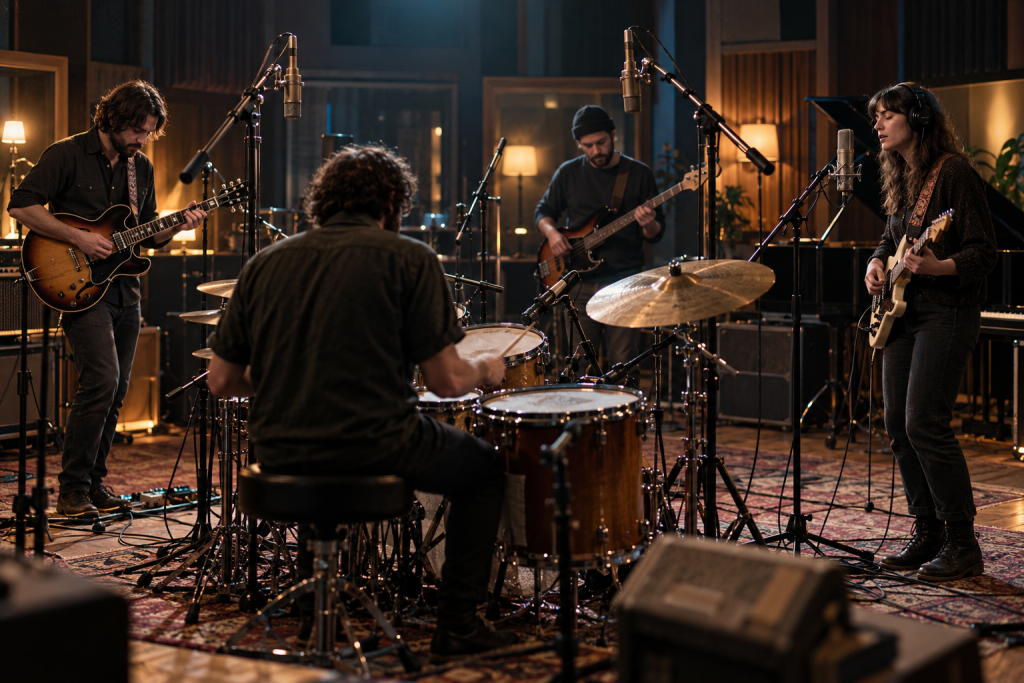
I record bands in one room. Not a live room with a control room and a glass window, just one treated space with the drums at one end and the amps at the other, and everybody playing at once because that is what the songs need. The take that comes out of that room is either usable or it isn’t, and the difference is almost never the gear. It is where the microphones went before anyone counted in.
What I care about is whether the live take leaves me room to fix things later. If the band plays well and the close mics are clean, I can replace a guitar or nudge a vocal without the room fighting me. If the bleed is wrong, every overdub I add has to fit around a mess I can’t undo. So the placement decisions below are all made with that in mind: protect the overdubs, not just the live take.
Start with the room, because the room is a mic you didn’t place
A modest microphone in a treated space will beat an expensive one in a bare room, and I’ve heard that play out too many times to argue with it. The same logic applies to a live band. You cannot close mic your way out of a bad room, because every one of those close mics is also hearing the walls.
Before I set a single stand, I figure out where the room sounds least like itself. Usually that’s not the middle. I clap in a few spots, listen for the flutter and the low mid build up in the corners, and put the drums where the room gives me the least. If I have a few spare panels or a heavy quilt, they get placed at the drummer’s back and on the wall in front of the amps. Nothing fancy. It just has to stop the room from being the loudest thing in every mic.
Close mics do the work, overheads decide the fate
The gated reverb trick from the 80s is a useful way to think about a live room, even if you never gate anything. The classic setup pairs close mics on the hit with ambience mics capturing the room, and the close mic is used as a key for a gate on the ambience so the reverb tail is chopped off right after the attack. The point of the gate is to let you have a live sounding kit without the secondary reflections smearing everything. I don’t run gates on the overheads, but the principle is the same one I apply to a live room: capture the hit clearly and keep the room from piling up behind it.
On the kit itself, close mics are for the shell of the sound and the overheads are for everything else, including how much room the drums bring into the rest of the session. If the overheads are too far back, they become a room mic that happens to have cymbals in it, and the whole kit drifts. If they’re too close and too wide, the cymbals smear across the stereo field and the toms lose their place. I keep them roughly equidistant from the snare, and I don’t obsess over a perfect measurement. My ear tells me when the snare sits in the middle of the image. That’s the target.
One thing I’ve learned the hard way: the overheads are the mic that decides whether the live drum take survives. If the bleed from the amps in the overheads is ugly, no amount of close mic work rescues it later. I’ll move a guitar amp a foot or turn it away from the kit before I’ll move the overheads. The drums are the anchor. Everything else can move around them.
Amps last, and quieter than feels right
Guitar amps in a one room session are a bleed problem disguised as a tone problem. The amp sounds great at the volume the player loves, and that volume is exactly what’s leaking into every drum mic on the kit. I put the amps behind gobos facing away from the drums where I can, and I ask players to turn down more than they want to. A slightly quieter amp with a good close mic will still sound like a loud amp in the mix. A loud amp bleeding into the snare mic just makes the snare drum sound like it’s playing in a guitar shop.
Directional mics help here. A tighter pickup pattern rejects more of the room and more of what’s off axis, which is worth more in a live room than a flattering frequency response. That’s the same reason a dynamic mic often beats a condenser in an untreated space: a take with less room in it is usually worth more than extra detail. In a one room setup, that detail is going to be somebody else’s amp anyway.
Bass I usually take direct with a mic on the cab as a backup. The DI is the clean fallback that survives whatever happens in the live take, and if the bass amp’s low end is muddying the room I can leave it out entirely and reamp or lean on the DI later. Having a clean, isolated version of one instrument in the live take is a huge relief when you get to the overdubs.
Bleed is a feature if you plan for it
Complete isolation is not the goal in a one room recording. If it were, I’d track everything separately and the band would lose the feel that made them worth recording. What I want is controlled bleed, the kind that glues the take together without trapping me in it.
The way you control bleed is with distance and direction, not noise gates. Getting the amps and the drums far enough apart helps. Aiming each mic away from the loudest thing it isn’t meant to hear helps more. And keeping the overall level in the room reasonable helps most of all, because the louder everyone plays, the more the room and the bleed dominate every mic. A quieter band that plays with intensity records better in one room than a loud one that doesn’t.
I also think hard about the vocal. If the singer is in the room with the band, that mic is going to catch everything. Sometimes that’s the sound, and the vocal bleed is part of why the take works. But if I know the singer will want to replace the vocal later, I either put them in a separate space or accept that the live vocal is a guide and the real one comes after. It’s a decision I make before we track, not after, because by the time the drum mic has a singer bleeding into it, I’ve lost the option to keep them apart.
What the placement buys you at mixdown
Here’s the payoff. When the close mics are clean and the room is under control, the live take leaves room for the overdubs. I can double track a guitar and have it sit beside the live one instead of fighting it. I can layer a few vocal takes for a thicker chorus, that same principle where slightly different takes create width and body that one take can’t, and the doubles will sit in a mix that isn’t already cluttered with room noise. I can ride a fader without uncovering a wall of bleed.
A rough mix of a well tracked live band should already sound like the band. If it doesn’t, no plugin is going to save it. The move I see people skip is spending the tracking time up front, before a note is played, on where everything goes. Two chord changes of a soundcheck is not enough time to sort out a room. I give it an hour if the band will let me.
If they won’t, I still move the amps. I still check the overheads. And I still make sure at least one instrument is captured clean and on its own, because that one clean source is the thing that lets me build the rest of the song back up when the live take is half good and I need it to be all good. The overdubs only have somewhere to land if I left them the space.