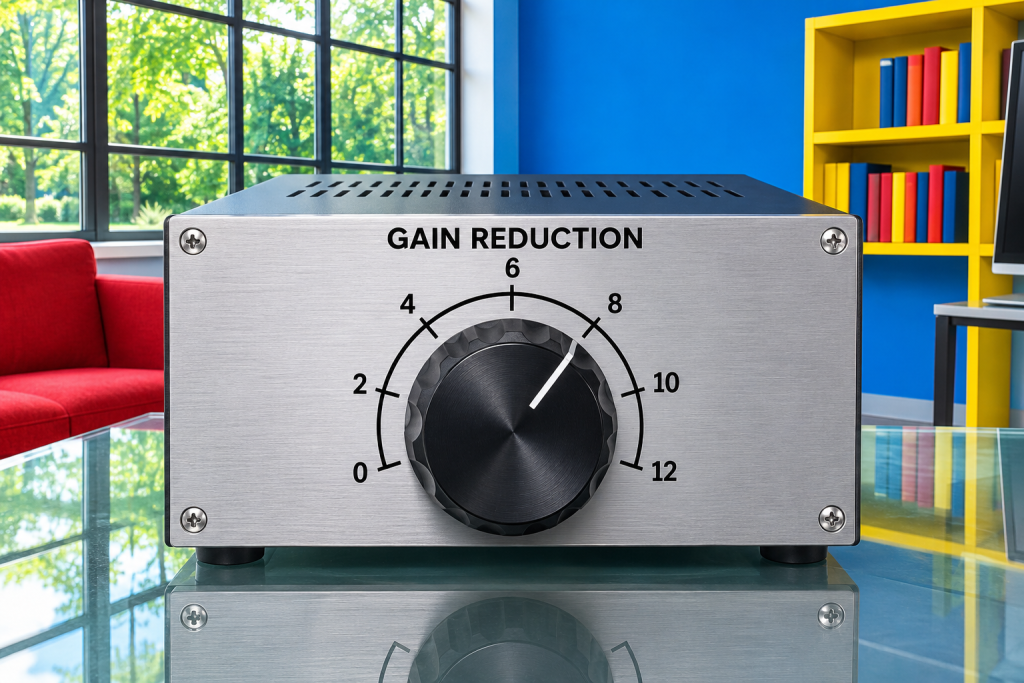
Three compressors under forty dollars, one drum bounce, no vocal to hide behind. I ran all three on the same stereo drum mix from a session I tracked last month: live kick, snare, two room mics, overheads, and a hi-hat track that I keep on a fader because the drummer plays it loud.
The bounce is dry. No samples, no parallel bus, no mix processing. Just drums into the compressors and out. That’s the only honest way I know to hear what a bus compressor does, because a drum kit shows you everything. Transients, low-end movement, how the room comes up, where the cymbals go when you lean on the gain reduction.
The three boxes
I picked these because they’re all under forty dollars and all marketed as bus compressors, which is a crowded and slightly dishonest category. Some of them are mix-bus tools. Some are drum-bus tools that got rebranded. Here’s what I found with each.
Safari Audio Sun Bear
Sun Bear is a mastering-grade bus compressor; it’s designed for glue, warmth and dynamic control on a full mix or an individual bus, and Safari’s Sam Loose says it’s based on the essence of his analog mastering chain, with transformer inputs, tube saturation, an M/S matrix and a master bus compressor in the box. The control set is Threshold, Attack, Ratio and Release, plus a sidechain filter for shaping how it reacts to low end, and a saturation section with Tape and Tube modes.
On the drum bounce it behaved like a mastering compressor should. The ratio goes down to 1.2:1 and the attack range starts slow, so with a gentle setting the kit stayed intact and the room mics sat a little closer to the close mics. The sidechain filter is the part I actually used. Kick the filter up and the compressor stops ducking on every kick hit; the low end holds its shape and the rest of the kit gets the glue.
Push it harder and the Tape and Tube modes start to color. Tape is the smoother of the two, a soft harmonic warmth that rounds off the top of the snare; Tube brings more harmonic excitement and feels more responsive, which on drums means it can get grabby if you’ve already got a lot of gain reduction going. I kept it at Tape for this bounce. At full price Sun Bear is a $129 plugin which puts it outside this test, but Plugin Boutique has run it at $4.99, so it’s worth checking the current price before you judge it against the other two.
The 1176 route
I used a 1176-style plugin for the second pass, specifically the UAD 1176 Classic Limiter Collection. It’s not strictly a bus compressor in the SSL sense; it’s a limiter with character and aggression, and the collection gives you three revisions of the original. Revision A, the Bluestripe, is the one that ends up on drum takes because of how its distortion sits in a busy mix. Revision E, the low-noise version, is more transparent. The AE revision has lower ratios for subtler gain reduction.
For a drum bus the trick is the all-buttons-in mode, which on the plugin you get by holding shift and clicking the ratio buttons. That’s the sound you hear on a lot of rock records: the kit seems to explode forward and the room comes with it. It’s aggressive and it changes the tone, not just the dynamics. On my bounce it made the snare sound like it had been hit harder than it was, and the overheads got a little crunchy. Good if the drums are supposed to sound like that. Wrong if you want the kit to stay polite.
At moderate settings with a slower ratio and a few dB of gain reduction, the 1176 style is a useful drum-bus compressor; it adds density without the smack of all-buttons-in. The catch is that it colors everything, and if you’re compressing a bounce that already has a lot of room in it, the color stacks up fast.
The SSL-style glue box
The third pass was an SSL Bus Compressor emulation. There are a lot of them: SSL, Waves, IK Multimedia, Slate Digital, Universal Audio, Cytomic, Native Instruments all make versions, and the point of all of them is the same punchy, energetic glue that pulls a drum kit together until the close mics stop sounding like separate takes.
The settings I start with on a drum bounce: slow attack, fast release, 2:1 ratio, minimal gain reduction. Slow attack lets the initial transient of the kick and snare through before the compressor clamps down, which keeps the punch; fast release lets the compressor reset between hits so it doesn’t pump. On a drum bus that combination tightens the low end and makes the room mics feel like they belong to the close mics. It’s not transparent, but it’s musical in a way the 1176 isn’t.
The problem with the cheap SSL emulations is that some of them sound like a compressor and some sound like a plugin that’s pretending. If you don’t already own one, this is the category where the price gap shows up most, because the top emulations are doing serious modeling work and the cheap ones are approximating the curve.
What I’d actually use
On this particular bounce, the Sun Bear was the one I kept going back to, because the sidechain filter let me keep the kick solid while the rest of the kit got glue. It’s the least drum-specific of the three and that turned out to be the point: I could dial it in to the kit instead of the kit having to fit the compressor.
The 1176 style is the one I’d reach for if the drums needed attitude, not glue. It’s a different tool. The SSL emulation is the safe default for a drum bus and the one I’d recommend to someone building a template, but only if they’re going to spend enough to get a good one.
None of the three rescued a bad drum take. That’s not what a bus compressor does; it makes a good kit sound like a record and a sloppy kit sound sloppy in a slightly louder way. If the drums are already half-good, which is the only state I ever get them in, all three will do something useful. The question is whether the something is glue, punch or attitude, and that’s a decision you make before you turn the threshold down.
One practical note from the session: I printed each pass and listened back the next morning in the car, because a drum bus that sounds tight in the room can fall apart on a small speaker. The Sun Bear pass held together best on the car system, which is the closest thing I have to a real-world test. The all-buttons-in pass was exciting and completely wrong for the song.