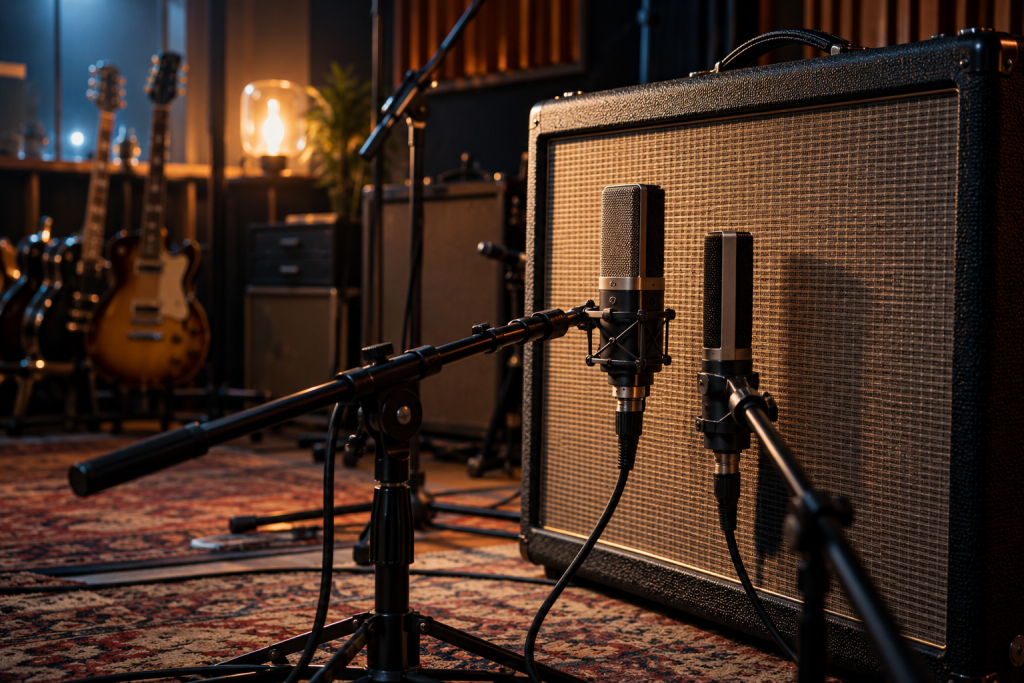
I keep two cheap ribbon mics in the cabinet next to the good stuff. One cost less than a decent dinner. The other was a return that a shop sold me at half price because the box was torn. Both get used on guitar cabs more than any condenser I own, and neither has ever let me down on a take I actually kept.
Ribbons have a reputation problem. People treat them as fragile, dark, fiddly things that only make sense on brass or room mics, and the cheap ones get written off as toys. Most of that is wrong. What matters on a guitar cab is whether the mic survives you putting a loud amp in front of it, whether the pattern rejects the wall behind you, and whether the sound sits in a track without a fight. Cheap ribbons do two of those three well and one of them badly. Here is what I have learned pushing them past the point a spec sheet would recommend.
The pattern does most of the work
A figure-of-eight ribbon rejects the sides hard. Put one a few inches off the grille and it hears the cone in front and the wall behind, and not much else in between. In my small room, which is not treated to any professional standard, that matters more than any smooth top end. A dynamic with a tight pattern buys you much the same thing, and the rule still stands: a take with some air left in it beats one stuffed with fine print. You can always add character later. You cannot un-smear a room.
A condenser in a bare room will pick up every early reflection off the ceiling and the back wall. The ribbon, aimed at the speaker cloth with its nulls facing the side walls, just doesn’t. I record cabs in a corner of my live room that I would never put a large-diaphragm condenser in, and the ribbon take plays back fine in a mix because the room never gets a chance to climb into the recording.
Whether it survives the amp
This is where cheap ribbons split into two camps. A passive ribbon has a thin strip of aluminium suspended in a magnetic field. Push too much air at it with a close-mic’d 4×12 and you can stretch the ribbon or, worst case, tear it. Loud guitar cabs are the classic way people kill ribbons. The fix is distance and a pop filter, or accepting that the mic stays three or four inches off the grille rather than kissing it.
The cheap ribbons I trust are the ones built with some protection against this, or passive models I only ever use at a slight angle with a windscreen. That costs a little top-end sizzle and gains me a mic that still works next week. If a ribbon has no protection and no bleed path, treat it like glass around a cranked amp. A modern active ribbon runs off phantom power and brings the ribbon’s sensitivity up so the preamp does less work, which I prefer for quiet cabs and clean sounds. The trade is that it now depends on phantom power being present and correct, and I have to remember never to send it down a jack that has voltage on it from a different device.
Dark, and how dark is too dark
Every cheap ribbon I have used rolls off the top and leans on the low mids. That is the sound people buy them for. A 57 is bright and nasal and cuts through dense guitar tracks. A ribbon is the opposite, weighty and soft. On a clean Telecaster through a small combo it sounds like a record. On a heavily distorted amp with a scooped mid, it can sound like a blanket laid over the cabinet.
My rule is that the darker the source, the less I want a ribbon on it. Bright, clean, jangly guitars get a ribbon. Fuzzed-out rhythm parts get the 57 or a condenser. And if I want one mic that covers both, I put the ribbon on one speaker and the 57 on another and blend them. That way I get the ribbon body with some bite on top, and I can walk the balance at mixdown. Two mics on one cab is not a luxury; it is how I avoid committing to a single character I might regret later.
The preamp question
Ribbons put out less level than a condenser. Some need a lot of clean gain. This is where cheap ribbons punish a cheap signal chain, because a noisy preamp gets exposed. The advice I keep coming back to is that the mic decides what your take can become, well before any plug-in gets a turn. A good mic into a modest interface beats a mediocre mic into a fancy preamp. But a low-output ribbon into a noisy budget preamp is the one case where that logic bends, because the preamp noise floor becomes part of the take.
My interface preamps are clean enough that a modern ribbon is fine at reasonable gain. If yours hiss at high settings, an active ribbon or a cloudlifter-style inline booster solves it without changing the character of the mic. The preamp character itself matters far less than the mic and the room until both of those are sorted. I stopped chasing preamp tone years ago; the cab, the mic position and the player are what I hear on playback.
Placement is the whole game
On a guitar cab the ribbon rewards small moves more than any other mic I own. A half inch toward the cone centre brightens it; a half inch toward the edge darkens and thickens it. Aim it dead centre or offset it toward the dust cap depending on how much presence you want. Angle it slightly off-axis if the amp is bright. These adjustments are free and they change the sound more than any plugin I could name.
I do the same thing on every session before I touch a fader: record the same riff through the ribbon at three positions and listen back on the monitors, then on a car. A mix that survives the car is the only mix I trust, and a ribbon take that sounds good on nearfields but turns to mud when I play it in the car usually just needs a little less low-mid. That is a placement or a small EQ move, not a different mic.
What I would actually buy
I would not spend much on a first ribbon. The point of a cheap ribbon is to find out whether you like the colour on your sources. A well-made passive ribbon from a reputable small builder, a pop filter and a stand will teach you more than an expensive model you are afraid to use. Keep the amp at a sane volume, place it a few inches back, and listen.
Skip the cheap ribbon if your only source is high-gain guitars, if your preamp is noisy at high gain, or if you record in a room with a long slap off the back wall the figure-of-eight will happily pick up. Skip it also if you want one mic to do everything; it does not. The reason mine stay in rotation is that they do one job, the dark weighty one, and there are plenty of days I do not want it. On the days I do, nothing else I own gets there as fast. That is enough.