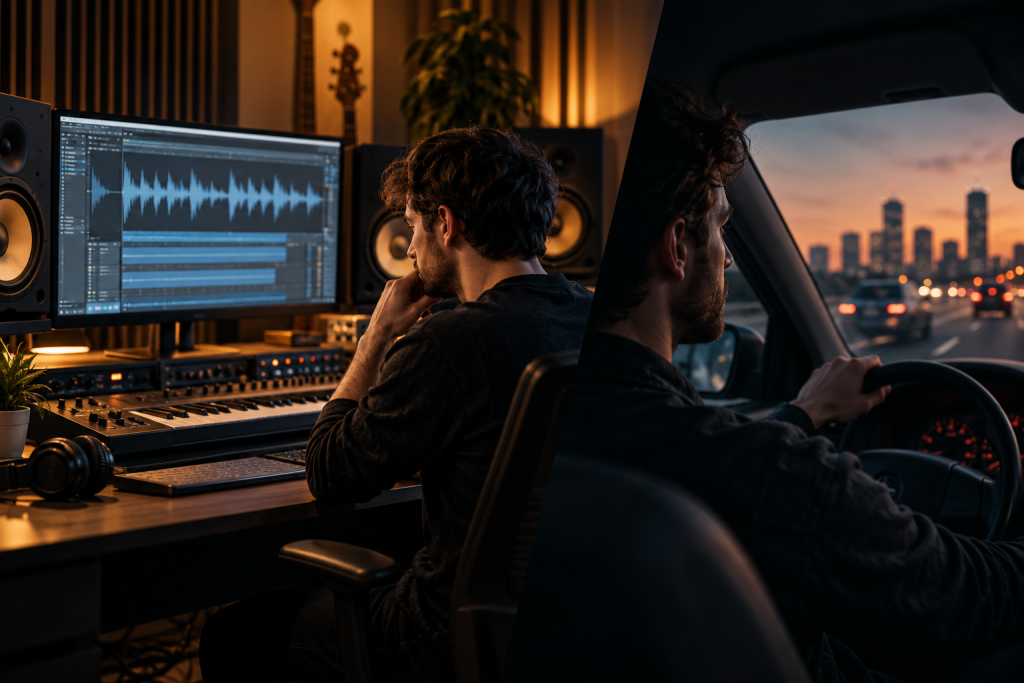
Every mix I finish gets played in my car before it goes anywhere. Not because the car is a reference system, but because it is a hostile one. There is a woofer down in the door card doing one thing, a tweeter up by the mirror doing another, and a cabin full of glass and plastic adding its own resonances on top. If the low end survives that trip, it survives most of the ways a real listener will hear it.
The complaint that brings people to my studio is nearly always the same sentence. It holds up on the nearfields and falls apart on a car stereo. I have heard it from vocalists, from guitar players who did their own rough mixes, from a drummer who sent me a track at midnight and asked why the bass disappeared. It is nearly always a bottom-end issue. And it is nearly always a matter of arrangement rather than level.
Two sounds sharing one fundamental
Kick and bass. That is the usual culprit. When the two land on the same fundamental, how they line up in phase changes with whatever you play the mix through. One system sums them in a way that feels big and round. Another system cancels half of it and the bottom drops out. A room with a nasty mode can hide the problem completely. A car exposes it because the car is a small, sealed box with a predictable set of resonances and no treatment whatsoever.
The instinct is to reach for a plugin. Pull up an EQ, find the muddy band, cut it. I have done that. It rarely holds, because the issue is not that a frequency is too loud. The issue is that two separate instruments are asking for the same space and neither of them has been given a reason to move.
You have to decide which element loses. The kick comes down a touch and the bass keeps its weight, or the bass gets sidechained to the kick so the fundamental clears for a few milliseconds every time the beater hits, or the 808 gets filtered so it lives in a different octave than the kick. That is a judgement about the music. It is not a measurement of it. Software that lines your mix up against a finished record won’t pull apart two sounds that arrived glued together.
What the car is actually telling you
A car cabin is a compression chamber with a listening position about a metre from one speaker and two metres from the other. Time alignment is a mess. Low frequencies build up in corners and cancel in the footwell. You are hearing a different phase relationship on every playback system because the room is different, not because your mix changed.
So the car test is not about whether the mix sounds good in the car. It is about whether the mix is robust. A robust low end holds together across systems because the kick and bass occupy complementary spaces, not because they were EQ’d to avoid each other by a fraction of a decibel that only works in one room.
I use three checks before I trust a low end.
First, mono. I fold the mix to mono and listen for anything that shrinks or disappears. A bass that relies on stereo width to feel big will vanish in a car where the speakers are closer together than your ears are in the control room. If the low end only works in stereo, it does not work.
Second, the phone speaker. Not to judge tone. A phone speaker cannot reproduce your sub. It can, however, tell you whether the kick and bass are contributing anything above 200 Hz that carries the groove. If the mix loses all sense of movement when the bottom is gone, the arrangement is leaning on frequencies most listeners cannot hear.
Third, a proper car pass. Windows up, then windows down. The change in cabin pressure shifts the resonant frequency of the space and often reveals whether your low end is balanced or just loud in one band.
Where plugins help, and where they do not
A dynamic EQ is genuinely useful here. One that reacts only when the signal crosses a threshold can tame a kick-bass collision without hollowing out the bass on every other beat. I use one on the bass bus, sidechained to the kick, with a narrow cut around wherever the two are fighting. The band only moves when the kick hits. On a good take it is nearly invisible. On a bad arrangement it is a bandage over a broken bone.
Multiband compression on the low end can do something similar by keeping the sub steady without touching the midrange punch. I use it sparingly, usually on the master bus, usually less than two decibels of reduction. More than that and I start hearing the compressor working instead of the song.
Saturation is the other tool I reach for. A little harmonic content on the bass gives the ear something to latch onto in the upper bass and low mids, which is where car speakers actually live. It does not add low end. It adds definition to low end that is already there. If the bass is thin to begin with, saturation just makes a thin bass sound distorted and thin.
What none of these tools will do is fix a mix that was never balanced. I have watched people chain four plugins on the master bus hoping to rescue a low end that fell apart because the kick and bass were fighting in the arrangement. The plugins process the problem. They do not solve it.
The car is not the problem
The most useful thing I can do when a mix falls apart on the drive home is not open another plugin. It is to go back to the arrangement and ask a simple question. Does the kick need to be there when the bass is carrying the melody? Does the 808 need the sub information the kick is also producing? Can one of them move?
Often the answer is to automate. The bass drops out for the first bar of the chorus and comes back with more impact. The kick gets a low-pass on the verses and opens up on the chorus. These are musical decisions, not technical ones, and they solve the problem at the source.
I still run every mix through the car. But I have stopped treating the car as a verdict. It is a stress test. It tells me where the mix is fragile. What I do about that is still a question about the song.